
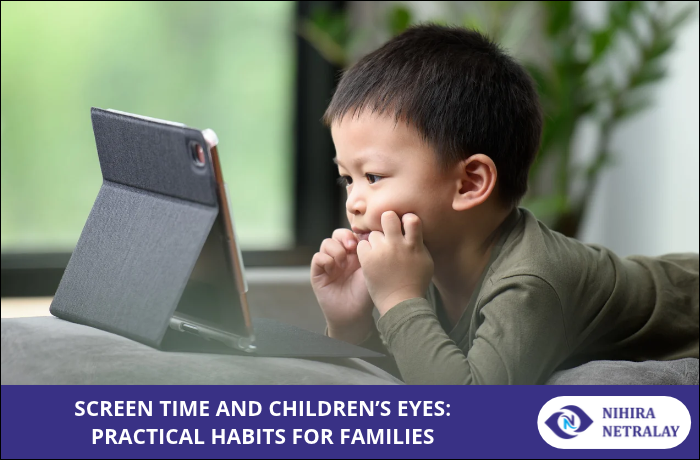
Long hours on phones, tablets, laptops and TVs can tire a child’s eyes, cause dryness and headaches, and take time away from outdoor play. Screens are not known to damage the eyes permanently in most children, but heavy near-work and little time outdoors are linked with a higher chance of short-sightedness (myopia). Simple habits such as regular breaks, a comfortable distance, daily outdoor time and a regular eye check-up can help families manage screen use.
This guide explains how screens affect children’s eyes, what signs parents can look for, which habits are practical for busy families and when to consult a paediatric ophthalmologist. It is general information and does not replace an eye examination.
How Do Screens Affect Children’s Eyes?
Children use screens for school, homework, games and entertainment. When the eyes focus at a short distance for a long time, a few things can happen:
- Eye strain: the focusing muscles work continuously, which can cause tired, aching eyes
- Less blinking: people blink less while looking at screens, so the surface of the eye can become dry and irritated
- Glare and posture: reflections, poor lighting and bad sitting posture can add to eye and neck discomfort
- Less outdoor time: time on screens often replaces outdoor play, which is linked with myopia risk in children
- Disturbed sleep: screens late at night can delay bedtime, and tired children often complain more of eye strain
Our post on digital eye strain: symptoms and prevention tips covers these symptoms in more detail.
Signs Parents Can Look For
Young children may not say that their eyes are tired or that they cannot see well. Watch for these signs, especially after screen use:
- Frequent rubbing of the eyes or excessive blinking
- Red, watery or dry-looking eyes
- Squinting or closing one eye while watching TV or reading
- Holding a phone, tablet or book very close to the face
- Sitting very close to the TV or the classroom board being hard to read
- Headaches, mostly after reading or screen time
- Tilting the head or turning the face to look at things
- Loss of interest in reading or a drop in school performance
These signs can also be caused by a need for spectacles, a squint or other eye conditions, so they should not be put down to screens alone.
Screens and Myopia in Children
Myopia, or short-sightedness, means distant objects look blurred while near objects look clear. It usually starts in school-going years and may increase as a child grows. Research suggests that many hours of close-up activity, such as reading and screen use, and less time spent outdoors are both linked with a higher chance of myopia. A family history of myopia also matters. Read more about myopia causes, symptoms and treatments.
If myopia is found, the doctor may discuss ways to correct vision and options to slow its progress, depending on the child’s age and eye measurements. Not every option suits every child.
Practical Screen Habits for Families
1. Set age-appropriate limits
The World Health Organization advises no screen time for infants under one year, and no more than one hour a day for children aged two to four years, with less being better. For older children, agree on clear daily limits that leave room for homework, play, meals and sleep.
2. Follow the 20-20-20 rule
Ask your child to take a break every 20 minutes and look at something about 20 feet (6 metres) away for at least 20 seconds. Set a timer or use a reminder until the habit forms.
3. Keep a comfortable distance and posture
- Hold phones and tablets at a comfortable distance, roughly an arm’s length where possible
- Place computer screens slightly below eye level
- Use a chair and desk of the right height so the child does not slouch
- Avoid screens while lying down or in a moving vehicle
4. Improve the lighting
Use a room with good, even light. Avoid screen use in a dark room, and reduce glare from windows or lamps falling directly on the screen.
5. Encourage blinking and eye comfort
Remind children to blink fully while using a screen. If the eyes feel dry, do not use eye drops unless a doctor has advised them.
6. Plan daily outdoor time
Outdoor play in daylight is good for general health and is linked with a lower chance of myopia developing. Make it a fixed part of the day, such as after school.
7. Switch screens off before bedtime
Aim to stop screens at least an hour before sleep and keep devices out of the bedroom at night. Enough sleep helps the eyes and the body.
8. Set an example
Children copy what they see. Family meals without phones and shared activities away from screens make limits easier to follow.
Many parents ask about blue light filter glasses. At present there is limited evidence that they prevent eye strain or eye damage in children. Please ask your eye doctor before buying them, and do not use them in place of spectacles that have been prescribed.
When Should You Take Your Child for an Eye Check-Up?
- Your child complains of headaches, tired eyes or blurred vision
- You notice squinting, eye rubbing, head tilting or sitting too close to screens or the board
- One eye seems to turn in or out, or the eyes do not look straight
- There is a family history of spectacles, squint or lazy eye
- Your child was born prematurely or has special needs
- It has been a year or more since the last eye check-up for a child who wears spectacles
Even without symptoms, an eye test before starting school is usually advised, since children often do not notice a problem in one eye. See our post on eye care tips for school-going children for more ideas.
What Does a Children’s Eye Check-Up Involve?
A paediatric eye examination is adapted to the child’s age. It may include checking how well each eye sees, how the eyes move and line up, and the spectacle power, often with eye drops that relax focusing so that the measurement is accurate. The doctor also examines the front and back of the eye. The drops may blur near vision and make light uncomfortable for a few hours, so plan for that on the day of the visit.
When Is It Urgent?
Seek prompt medical care if your child has sudden loss of vision, eye pain, a red eye with light sensitivity, an injury to the eye, or double vision. Do not wait for screen habits to change in these situations.
Frequently Asked Questions
Does screen time damage children’s eyes permanently?
Screens are not known to cause permanent eye damage in most children. They can cause temporary eye strain and dryness, and heavy close-up use with little outdoor time is linked with a higher chance of myopia. An eye check-up can tell whether a child needs spectacles or other care.
How much screen time is safe for a child?
There is no single limit that suits every child. The World Health Organization advises no screens for infants under one year and no more than one hour a day for ages two to four years, with less being better. For older children, set daily limits with your child’s doctor or school guidance in mind.
Can screens cause myopia in children?
Screens alone have not been proven to cause myopia, but long periods of near work and limited outdoor time are linked with it. Family history is also important. Regular eye tests help find myopia early.
What is the 20-20-20 rule?
Every 20 minutes, look at something about 20 feet (6 metres) away for at least 20 seconds. This gives the focusing muscles a short rest and reminds the child to blink.
Do blue light glasses protect children’s eyes?
There is limited evidence that blue light filter glasses reduce eye strain or protect the eyes in children. Ask your eye doctor before buying them, and use only the spectacles that have been prescribed.
When should I take my child to an eye doctor?
Book a visit if your child has headaches, squints, rubs the eyes, sits very close to screens or the board, or if one eye turns. A routine eye test before school age and then as advised by the doctor is also sensible.
Book an Eye Check-Up at Nihira Netralay, Nerul
If you are worried about your child’s eyes or screen habits, an eye examination can help find the cause and the next step. Dr. Ankita Patil Kulkarni (MS Ophthalmology, Fellowship in Paediatric Ophthalmology and Squint, Sankara Nethralaya, Chennai) is a paediatric ophthalmologist. Read more about Dr. Ankita Patil or about paediatric eye care.
- Nihira Netralay: Sector 28, Nerul, Navi Mumbai, Maharashtra 400706.
- Phone: +91 87796 90795